Title : Tai Chi Moves for Beginners: Harvard Scientists Now Back This Ancient Exercise
link : Tai Chi Moves for Beginners: Harvard Scientists Now Back This Ancient Exercise
Tai Chi Moves for Beginners: Harvard Scientists Now Back This Ancient Exercise
Oriental medicine practices have always placed a strong emphasis on prevention and treatment of diseases naturally whenever possible. Now, in many ways, Western medicine is catching up, especially when it comes to the use of tai chi moves to improve the mind, body and heart. A growing number of people around the world are now interested in traditional Oriental healing systems - including Tai chi, yoga Acupuncture and meditation - due to the growing evidence that they can help prevent and treat many health problems such as arthritis, anxiety and chronic pain.Medical School Harvard reports that although tai chi is a slow and gentle practice that effectively addresses several core benefits of exercise : increase muscle strength, maintaining flexibility, improve and maintain balance and sometimes even provide an aerobic workout that is important for your heart. Harvard researchers have even recently published a guide for tai chi, indicating that a regular practice for as little as 12 weeks could help give a "healthy body, strong heart and mind sharp."
What is Tai Chi?
Tai chi is a mind-body exercise rooted in many Asian traditions. It is one of the many types of qigong exercises , which combine the principles of martial arts, controlled breathing, traditional Chinese medicine and Eastern philosophies. In the West, the deeper meanings and importance of tai chi can be somewhat difficult to explain, considering it has a long history dating back thousands of years. Tai chi movements also involve components that are not easy to translate. Tai chi derives its name from Eastern concept of yin and yang; in fact, the circular symbol black and white representing yin yang is also often used to represent tai chi - as it is said that the practice of attaching Tai chi is also deeply rooted in another "body and mind." This ancient philosophical concept that is still foreign to most Westerners :. " Qi ", which could be translated as life force or vital energy Research shows that Tai Chi has many benefits for both young professionals and older. However, he gained more attention for its strong anti-aging effects. A report published in Official Publication of the Medical Society of the State of Wisconsin provides that. "Tai chi is a form of exercise especially effective for elderly tai chi exercises is a relatively low-tech approach for the prevention of disability and maintain physical performance in older adults. "who can benefit from tai chi movements?
Most Western research is investigating the health benefits of qigong, including tai chi. Increasingly popular in the US and Europe, tai chi movements are adaptable for different audiences and well suited to handle many different health conditions. A 2010 meta-analysis in American Journal of Health Promotion includes more than 70 articles published and found that Tai Chi offers benefits in several categories of results: improved bone density, cardiopulmonary effects, physical functioning , quality of life, self-efficacy, psychological symptoms and immune function. Based on the fact that it can help control stress and low cortisol levels , pain in the lower limbs, to build strength and endurance, reduce the risk of falls or injuries and improve the immune system, people who can benefit from tai chi moves most include those with:- limited physical abilities, including older adults who are not able to do strenuous exercise . Tai chi and other forms of qigong are most popular among the middle-aged to older adults. Many doctors believe helps them regain flexibility and strength, while helping people stay calm in times of stress. For older adults, tai chi, also it reduces the risk of falls and can improve recovery time of injuries or illnesses.
- chronic stress
- heart disease, high blood pressure or high cholesterol
- muscle aches and pains
- pain joint , osteoarthritis or tendonitis
- fatigue, lack of energy and difficulty sleeping
- learning disabilities, including ADHD
- under the function of the immune system and susceptibility to infections or diseases
- those with other circulatory, lymphatic and digestive problems (such as intestinal or kidney problems)
6 Benefits of tai chi movements
1. Increased flexibility As a type of fluid exercise body weight movements of tai chi help increase the upper and lower body flexibility, along with coordination and strength. Tai chi movements are carried out in many different positions, sometimes standing or sitting, which helps to warm up, stretch and relax tense muscles and joint tissue. Most tai chi classes or routines begin with a warm-up period for ease in movements such as shoulder circles, turning his head from side to side or rocking back and forth. Over time, this practice can reduce the stiffness, aches, sprains, falls, injuries or tears.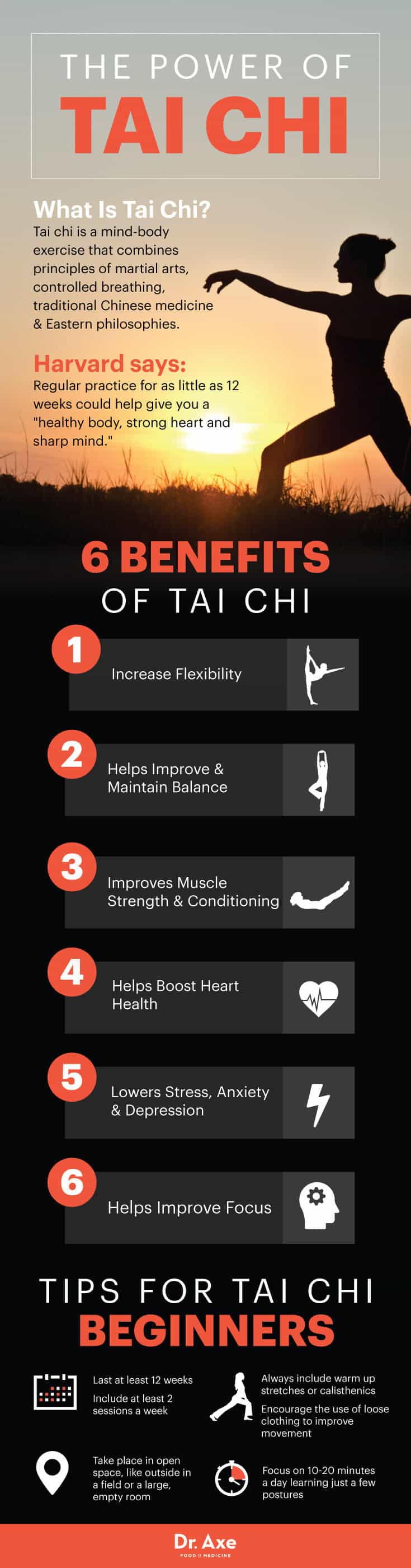 improved and better maintained balance Researchers from the University of Liverpool found tai chi may improve balance and strength, along with reducing the risk of falls in the elderly, especially the "high risk". Tai chi also helps in proprioception , the ability to perceive the position of the body in space. Proprioception generally decreases as one ages because of changes in the structure of the inner ear, along with the decrease in strength of certain muscles and ligaments. Tai chi helps proprioceptive sensory neurons train in the inner ear and restore muscle strength and coordination. A documented balance and cardiovascular response to a community of middle-aged women change study. relatively sedentary, but healthy women 33 to 55 years old participated in the exercise tai chi three times a week. After 12 weeks, compared with the control group, women doing tai chi movements experienced significant improvements in "dynamic equilibrium", measured by the functional reach test. Tai chi is also significantly reduced both systolic and diastolic blood pressure, showing that protection has multiple benefits for older adults. ( 5 ) 3. Improved muscular strength and conditioning movements of tai chi can also improve both the lower body strength and the upper body strength while even comparable to other forms of mild resistance training, such as yoga or using tapes and power lines. Tai chi improves upper body strength by incorporating many unsupported arm exercises that involve holding arms up. You can also improve the strength of the knee and lower body, core muscles, back and abdomen due to the incorporation of dynamic movements like lunges leg, squatting movements, spins, kicks , squats and bends. ( 6 ) 4. better heart health Tai chi helps lower blood pressure by reducing of the body's response to stress, improves "gas exchange" and breathing, can help reduce inflammation and sometimes it can serve as an aerobic exercise. Harvard Medical School notes that the fastest forms of movement of tai chi have similar benefits to brisk walking. Studies show that regular practice of tai chi helps improve heart strength and durability of blood vessels and other body tissues. It also helps to lower inflammatory responses caused by an overactive autonomic nervous system. 5. Reduce stress, anxiety and depression Many see the tai chi as much more than an exercise. Historically, tai chi has a strong spiritual dimension and promotes greater self-awareness. Studies show that tai chi is a natural stress reliever and promotes positive effects on depression and anxiety in a manner similar to yoga or other mind-body exercises manner. ( 7 ) Often people find that control breathing and the approach involves the practice of tai chi promotes a calm mind, increased connection with others, patience, compassion and acceptance. The practice of tai chi outdoors in a natural setting, like a park or on the beach, can also reduce stress what a person's attention to the way they connect with their environment, a greater purpose and people living around them. 6. more precise approach Studies suggest that the slow pace of tai chi, attention to detail and helps lower circular movements "mind chatter" and improve care. People often describe the tai chi as a " moving meditation " because it is following the breath in a rhythmic way that makes diminish rumination or wandering thoughts. Some people choose to further improve the selection using practices such as visualization, images, mantras or affirmations while performing tai chi movements.
 Tai Chi exercises and training
People often practicing tai chi as a series of fluid motions that accompany breathing. Series of movements can vary in length from about 15 minutes, all the way to 2 hours. Chen Meng was a master of tai chi that is now credited with creating a popular version, abbreviated tai chi traditional lasting about 15 minutes. His method, which has influenced many others to create other similarly short series, it is considered good practice tai chi for beginners. Before beginning the practice of tai chi, consider these tips:- Tai chi series usually require a significant amount of open space, so which it is common to practice outdoors on a field or in a large empty room (gym).
- Tai Chi programs for beginners over a minimum period of 12 weeks with practices that take place at least twice a week.
- Always be sure to start with a brief warm; for several minutes practicing simple stretching or calisthenics to move the legs, arms and back. Wear loose clothing that allows you to move and stay cool.
- For beginners tai chi, it is usually best to take things slow and spend 10 to 20 minutes a day learning a few positions rather than rushing through a full routine.
- position Beginner: This is the most basic movement tai chi (also known as a pose) . It requires the feet to be the distance of the shoulders, toes pointed slightly inward, smooth knees, chest and chin slightly cupped, and hips slightly. Some describe the pose as if you were sitting on a high stool.
- Tai Chi Basic Step: step by step is an important step in tai chi movement, and is necessary for a smooth transition smoothly from one to the next. Stepping is done in a swinging motion, placing your feet with the weight balanced one against the other. Keep your center of gravity, while stepping and rolling around the foot so that both feet rest on the floor in the final position.
- The power increase: This movement is often used as an opening or closing of a series. It is also known as "catch a ball" or "Ball of Energy." Its action is to rub your hands and then pull them. Bring near each other once again, but do not let them touch. Feel the warmth and energy (qi) between your hands as you continue the practice of this movement, perhaps while stepping at the same time.
- Withdrawal and push: This movement is used to "cleanse the body" and requires movements forward and backward like a wave. Start with one foot before the other, with his weight on his hind legs. Circle hands up in a wave motion, lift the back heel, roll / move the weight forward as a moving up and through the body wave imagines.
- Brush Knee: This movement helps strengthen arms, relax muscles and focus the mind. The weight is centered between the legs and arms are held outward. As rises on one side, the other sinks (a palm is up and one down) in a rocking motion. As a step forward, his torso and arms becomes alternate positions.
- Roll back / Guard Exterior: This movement uses the waist and is performed in a diagonal position. Put weight on the left leg and turn the waist to the left. The curves of the right arm holding a ball against his chest, the fingers move upward, while the left arm arcs down first, then the left arm fleet to shoulder height.
- Single Whip: This position of the moving hand is typically used for jabbing, whipping, beating or even massage. Place your hand with the palm facing down and the four fingers bent to touch the thumb slightly. The front leg extends outward, open to the side, front arm moves forward and the wrist is bent downward while the fingers are opened and closed body.
vs. Qigong Tai Chi:? How do they relate
- Qigong is an ancient Chinese practice of health care that has been in existence for over 2,000 years. Tai chi is a form of qigong; It is far from the only type, but is probably the most well-researched today.
- There are thousands of different styles of qigong is practiced worldwide, all of which physical postures, breathing techniques are integrated and focused intention (as does tai chi).
- The benefits of different forms of qigong range depending on the exact type. The benefits may include reduced stress, decreased joint pain, improves heart health, better physical functioning, improves balance and fall protection.
- Some of the things that make the different chi tai other forms of qigong is that Tai Chi is a specific series of postures and exercises, while qigong can be practiced without any particular order.
- Tai chi is one of the most popular forms of qigong in the West and is a soft, slow style, flowing martial arts. But qigong itself does not always have to be made in this way. For example, qigong can also be static, such as the style called Zhan Zhuag, or very rapid and intense, as the style called Dayan. Tai chi practices vary from anywhere between 10 minutes to 2 hours.
History of Tai Chi
As a form of qigong with a history dating back over 2,000 years, tai chi has been interpreted and influenced by many different leaders. Tai chi is believed to have been influenced by Taoist, Buddhist and Confucian philosophies. Historically, tai chi training and knowledge is transmitted from a master to a dedicated student, who has created different lineages and many unique methods. Tai chi refers to yin / yang in several important respects, including how practice combines two of courtesy, but opposite, the energy forces that lead to the overall balance and health.- The yang aspect of tai chi refers to how effectively increases strength, stamina and energy, while the yin aspect refers to the way that improves concentration, a sense of It is grounded and introspection.
- Yin / Yang can also be applied to tai chi in your practice body parts oppose improve coordination and balance are used. The left and right and top and bottom
- probably the most important way that yin / yang applies to tai chi is how it connects the physical body with the cognitive mind. Tai Chi consists of movements performed simultaneously with controlled breathing and concentration, which helps improve relaxation, attention, self-awareness and confidence through visualization, intention and images.
- Qi represents the energy flow in the body and is said to be balanced and maintained through physical activity, along with breathing exercises and concentration. For this reason, tai chi is said to improve the mind-body connection and provide physical and emotional benefits at the same time.
- It is true that most of the eastern philosophical and medical concepts, tai chi is based on the fact that all aspects of a person and the whole body is connected; the mind affects the body, and the body affects the mind.
Precautions Tai Chi
movements of tai chi are considered a very safe form of exercise even for people with skills limited, however, there are some circumstances in which it is better to talk with your doctor before starting. If you have a wound that is still healing, no limitation of musculoskeletal problems or take medications that can cause dizziness or vertigo if your heart rate increases, it is a good idea to get a professional opinion first.It recommends that beginners tai chi instruction have a class to learn the movements safely and get feedback. centers elderly low cost centers or community education often offer tai chi classes. You can always choose to view online instructional videos for free, too. Note that there are no formal training requirements or authorization for tai chi instructors, so look for a reference in your area and do your research to learn from someone who is knowledgeable and experienced. The Tai Chi Health Center offers help finding an instructor or become an instructor himself.Final Thoughts on movements of tai chi
- Tai chi is a form of qigong exercise that has practiced for thousands of years.
- combines controlled breathing, concentration and slow movements throughout the body.
- Tai chi benefits include reduced stress, decreased joint pain, improved heart health, better physical functioning, improves balance and fall protection.
- movements of tai chi are safe for people of all ages and especially beneficial for older adults. You can help prevent injuries, improve immunity deficiencies and relieve psychological stress.
Source: draxe.com/
You are now reading the article Tai Chi Moves for Beginners: Harvard Scientists Now Back This Ancient Exercise Url Address https://healthnbeautyarticles.blogspot.com/2016/07/tai-chi-moves-for-beginners-harvard.html
Thanks for Reading Tai Chi Moves for Beginners: Harvard Scientists Now Back This Ancient Exercise
Thank you for reading this Tai Chi Moves for Beginners: Harvard Scientists Now Back This Ancient Exercise, hopefully can give benefits to all of you. well, see you in posting other articles.
You are now reading the article Tai Chi Moves for Beginners: Harvard Scientists Now Back This Ancient Exercise Url Address https://healthnbeautyarticles.blogspot.com/2016/07/tai-chi-moves-for-beginners-harvard.html
0 Response to "Tai Chi Moves for Beginners: Harvard Scientists Now Back This Ancient Exercise"
Post a Comment